

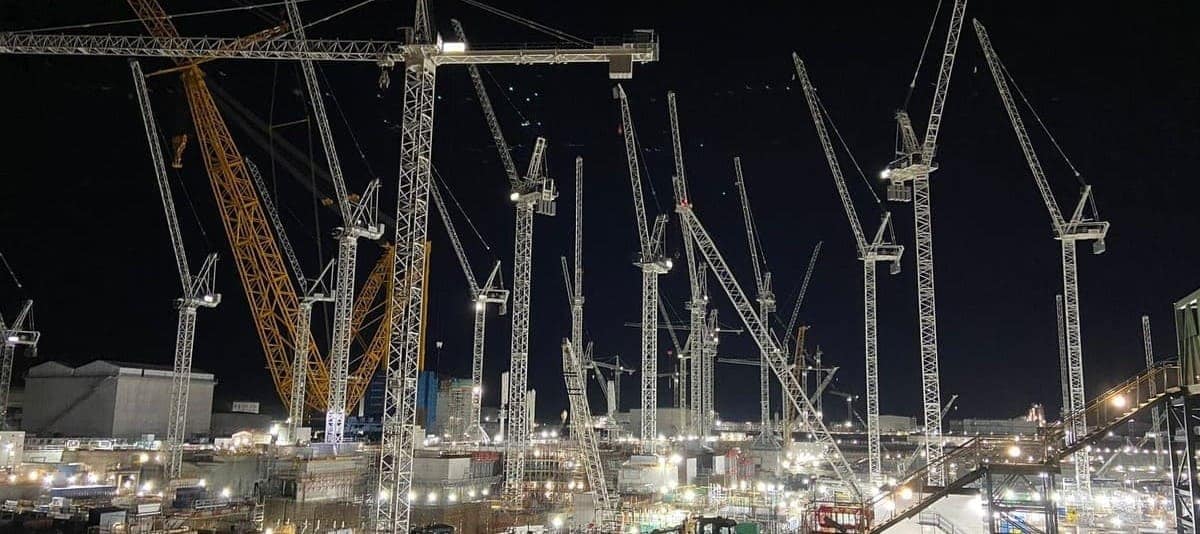
One of the most important factors in the crane industry is the wind conditions. Wind can affect lifting for many reasons.
Here are some things to consider when operating cranes in high windy conditions:
- Size, weight, and surface area of the load.
- Wind speed limits in lift plans.
- Height of the crane.
- How high the lift is going.
- Open area vs sheltered by a building.
- Wind channels. (Between buildings.
- Radius you’re working at.
- Blind lifting. (When the driver can’t see the load).
- The experience of the slinger/signaller.
We’ll look at these factors in more detail. But first, let’s talk about why wind can be an issue when operating cranes.
Here is what you’ll find in this article.
- Why is wind an issue?
- What are considered high winds?
- Maximum wind speed limits
- 1. Size, weight, and surface area of the load.
- 2. Wind speed limits in lift plans.
- 3. Height of the crane or crane jib.
- 4. How high the lift is going.
- 5. Open area vs sheltered by a building.
- 6. Wind channels.
- 7. The radius being working at.
- 8. Blind lifting.
- 9. The experience of the slinger/signaller and ground personnel.
- Can wind speed affect a crane’s lifting capacity?
- Assertiveness.
- Wind speed alarms
- Self-Erecting Tower Cranes (SETCs)
- Conclusion
Why is wind an issue during crane operations?
Wind can be an issue on sites for any machine that lifts materials or people. This can be scissor lifts, cherry pickers, external personnel hoists, all crane categories, etc.
The reason is wind makes the machinery or the materials they carry unstable, and sometimes difficult or even impossible to control.
There’s a common misconception that wind speed is the factor that makes loads or machinery unstable, where, in fact, it is wind pressure. But wind pressure does vary depending on wind speed. For example, if wind speed doubles, wind pressure increases by a factor of four.
This pressure pushes against the cranes and their hook blocks and loads, making controlling the loads difficult. The pressure is also known to tip over cranes or collapse jibs. Here is a news article about a crane’s jib that blew over in the wind.
What are considered high winds?
This can be determined by a whole manner of things. But the bottom line is, any lift being done that can’t be controlled because of the effects of the wind means it is being done when the wind speed is too high. This is why wind speed limits, as per lift plans, get put in place.
There are maximum wind speed limits to stick to across the board for each crane category (we’ll discuss them shortly). And there are also limits for specific items to be lifted, determined by each site’s lift plan. What might be too windy for lifting one object might not be too windy for another.
Maximum wind speed limits
Each crane category has its own maximum wind speed limit. This is the wind speed that, when reached, the crane should be taken out of service. More commonly known as ‘winding off’.
Also, each crane manufacturer sets their own guidelines for their cranes, so the limits can be different for every make. The relevant personnel who order or set up the crane should get this information from the manufacturer or hire company.

Here is a general guide for the wind speed limits of the main cranes used on UK construction sites.
- Tower cranes – 38mph (61kph)
- Crawler cranes – 12m/s (43.2kph/26.8mph)
- Mobile cranes – 12m/s (43.2kph/26.8mph)
Notice that tower crane wind speeds are measured in miles or kilometres per hour, whereas wind speeds for crawler and mobile cranes are measured in metres per second.
According to the Construction Plant Hire Association (CPA), these limits don’t mean that the crane operator must carry out lifting at any wind speeds up to these specific limits. Ultimately, it is down to the driver’s discretion to not lift certain loads or even wind-off (cease all lifting) at lower wind speeds. Decisions are made by assessing the listed factors below.
The CPA also state that the driver’s decision should not be overridden by site management under any circumstances.
But in the same respect, drivers should not take the crane out of service so that they can be lazy and get out of work. Unfortunately, this does happen.
Wind speeds should be monitored at all times. When wind increases, every lift should be assessed by all involved. Also, the lift plans of some crane hire companies state that immediately after the out-of-service wind speed has been reached, the driver should wait for there to be 30 minutes of workable wind before going back to work.
Now we’ll cover some things to consider while assessing wind in crane operations.
1. Size, weight, and surface area of the load.
If the wind is high, certain loads will blow easily, which can make them difficult to control.
Here are some loads that could easily catch the wind:
- Loads with large surface areas. Like shutters, glass panels, cladding, screens, etc.
- Light loads.
- Excessive amounts of slings between the load and the hooks.
- Long wire bonds used to carry the load.
- Long loads, like beams or scaffold poles.
Examples of some loads that can get affected by high winds.


Loads with large surface areas are probably the primary concern when lifting in windy conditions. Especially if the loads are thin, like shutters or glass panels. The larger the surface area, the more there is for the wind to blow against. Think of a sail on a boat or ship.
2. Wind speed limits in lift plans.
As mentioned previously, wind speed limits vary for certain lifts. To give a couple of examples, the wind speed limit for steel erecting is generally 45km/h (28mph). Whereas the wind speed limit for using vacuum lifters is 29km/h (18mph).
If a steel beam is on the hook and is caught by high winds, it could spin like helicopter rotor blades. This could make life difficult for anyone trying to hold on to the beam, and it could be extremely dangerous.
Every contractor involved with lifting on each site will sign up to the site’s lift plan. The lift plan is also known as the Schedule of Common Lifts. Some contractors that do the majority of work will also have their own lift plans that require the signatures of all lifting personnel.
The Schedule of Common Lifts covers all lifting that is done on a day-to-day basis. But there is sometimes the odd contract lift that will have its own set of guidelines to sign up to.

These lift plans must be read and signed on the first day of arriving on site before carrying out any lifts. The lift plans detail how each load should be slung. They also explain the wind speed limits to take into account when lifting certain loads.
So, it’s a good idea to remember these wind speed limits when asked to lift certain loads. If unsure, the driver should ask the Appointed Person (AP) or Crane Supervisor.
3. Height of the crane or crane jib.
Most weather forecasts are measured at only 10m above the ground. But the higher the altitude, the higher the wind speeds get. These wind speeds vary depending on terrains and surrounding buildings. Sometimes, buildings can shelter cranes from the wind.
Here is a tool that calculates the increase of wind every 10m up.
If the calculator is too confusing, here is a guide provided by the CPA:

This means that a tower crane at 30m high, for example, won’t get affected as much as one at 100m.
4. How high the lift is going.
This ties in with the previous section but is lift specific. In windy conditions, if a load to be lifted is susceptible to catch the wind easily, the driver should determine where the load is due to go.
If the load is due to go high into the air or across the other side of the site, the driver is well in their rights to refuse the lift. However, there may be alternatives. If there is a chance to keep the load at a low level, where it can be held on to at all times, this might be something to consider. This is called a ‘controlled lift’ or a ‘local lift’.
This can take a lot of skill. Especially if the load needs to be kept low for a long distance, weaving in and out of obstructions or moving between different levels.
5. Open area vs sheltered by a building.
If a lift is to be done in an open area (as in no buildings or high terrain to block the wind), the load is quite likely to get caught by gusts. Whereas, a lift done next to a building or in an alcove can sometimes get protected from wind.
However, whether the load is sheltered or not, the jib can also get blown around by the wind. In some circumstances, the wind can even blow the wind through the slew break. The slew break locks the crane in place when it has stopped its slew motion. When the wind pushes through that, the brake fails and lets the crane move round, which can cause collisions.
Also, if an incident happens when the driver is working above the recommended wind speed but feels that the load is protected by a building, they will be liable. Having the load protected by a wind block won’t go in their favour, because they still lifted in excess of the wind speed limits.
And buildings don’t always protect loads from wind. It depends on the height of the buildings and what direction the wind is blowing. Sometimes, buildings can create wind channels.
6. Wind channels.
Wind channels are created when wind gets funnelled between obstructions, like buildings. The pressure of the wind increases, making it faster. For example, when you hold your thumb over the end of a hose, leaving a small gap, the water shoots out quickly at high pressure.
This can make lifting between buildings problematic if wind is travelling through that gap. So, even if the crane anemometer at the top of the jib or A-frame isn’t giving a high wind reading, the hook block and load could swing uncontrollably.
7. The radius being working at.
The two extremes of the crane’s radius can influence how the crane operates in high winds.
The further out on the jib the hook is, the harder it is to control where the hook goes. At maximum radius, one small tap on the slew to move the crane a foot to the left or right, for example, can actually move the crane a metre or more.
High winds add to this difficulty. Cross winds (winds that travel across the jib) push against the jib, which creates a rocking motion. Sometimes, keeping the jib in a still position can be very difficult. Other times, slewing into the wind can be almost impossible.
(There are slew torque settings on most cranes that can be adjusted to suite).

So, there are times when a crane driver should notify site personnel that there is to be no lifting near maximum radius. Especially when the jib is to face oncoming wind.
In the same respect, using a luffing crane at minimum radius in high winds can create a similar issue. The jib will be almost vertical, so wind pushing against it can make the crane rock, which will in turn make the hook block swing.
But more importantly, if the jib is up at minimum radius in high winds, there is a risk of the wind blowing the jib backwards to collapse over the crane. This can especially happen when lifting light loads, as is what happened on a fateful day in Liverpool in 2007. Here is a report from the Liverpool Echo.
The likely sequence of events of this incident is reported to be:
- Whilst the crane was lifting a light load with the jib nearly vertical, a gust of wind, at or above the safe working limits of the crane, raised the jib, which released tension on the luffing rope.
- The luffing rope then came off the sheaves and jammed in the reeving system. The crane driver then tried to jib down, but because the rope was jammed, lots of slack formed as the luffing drum released the rope at the other end. This formed a loop at the rear of the back jib.
- The jammed rope then freed up, which sent the jib into free fall because there was no tension on the jib.
- This caused a huge shock-load, which bent the jib. The bolts holding the main crane assembly failed and the slew ring fractured. The crane assembly then fell, landing upside down on the building below it.
- The concrete ballast weights fell out, killing a worker in the building.
This is similar to what can happen if a crane is not left in an out-of-service position (in free slew). There have been incidents where wind forces against the structure of the crane, creating unnatural strain against the jib, which can make the jib collapse. As explained in this HSE Safety Alert.
Unfortunately, this is the harsh reality of what can happen through negligence, bad practice, lack of concentration, or freak weather conditions.
8. Blind lifting.
A blind lift is where the crane driver can’t see the load that is to be picked up, or can’t see where the load that they have on is going. In this instance, the crane driver is solely reliant upon the slinger/signaller to guide them, unless a hook camera is fitted.
Blind lifts are always more difficult for a crane driver. Therefore, if they can see everything they’re doing in windy conditions, there’s more chance of maintaining control of the hook. Whereas, if the hook or load is blowing around in the wind when the driver can’t see it, this can be dangerous.
9. The experience of the slinger/signaller and ground personnel.
This ties in with the previous section. There needs to be trust between the crane driver and slinger/signaller. Especially when doing lifts that could be tricky.
When assessing how or when to carry out a lift in windy conditions, the crane driver should know how experienced the people they’re working with are.
They need to that the slinger/signaller will keep calm and know what to do in tricky situations. They need to know that the trades or labourers are skilled at controlling the tag lines.
Also, all personnel need to be in the correct positions to take control of the load straight away, so that it doesn’t remain suspended for long periods.
In the construction industry, as much as planning and briefings are essential and useful, there will always be something that doesn’t go to plan. Experienced workers know solutions to problems. They keep composure. This calmness and confidence travels through the radio to the crane driver.
With this being said, at no point should lifting personnel take unnecessary risks.
Can wind speed affect a crane’s lifting capacity?
High wind can affect a crane’s lifting capacity for a couple of reasons
1.
From minimum radius to a certain point (usually between 18-20 metres), a crane can lift to its maximum capacity. This point differs with each crane manufacturer. After this point, the lifting capacity decreases as the radius increases.
When wind blows the load further out than a radius that’s plum to the crane, it creates more stress on the jib, which decreases the lifting capacity at that point. This is the same reason, among others, why loads shouldn’t be dragged from further than the crane can reach.
Let’s give an example. Say the crane is concreting using a 3m concrete skip. Fully loaded, the screen reading might say that it weighs 10t. This is quite heavy to be lifting near maximum radius.
There are sensors on cranes that warn drivers when the crane is approaching its full lifting capacity. Once that capacity is breached, an alarm will ring and motions get automatically stopped.
If this skip gets jibbed all the way out to maximum radius, it could have a large jib swing or get blown back and forth by high winds. Now, if 10t is close to the maximum lifting capacity at maximum radius, an alarm will sound when the skip swings past plum. When it swings back in, the alarm disappears, and so forth. But the hoist can get cut as a safety measure.
2.
Similar to wind creating a jib swing (forwards and backwards) as above, crosswinds force sideways swings. This can create side loading on the crane. Cranes are only designed to bear weight vertically. When loads put sideways tension on jibs, lifting capacities can decrease. But more importantly, it could cause structural damage, or even tipping over of cranes.
Assertiveness.
Construction sites can be quite overwhelming. At any given time, there could be 200-1500 or more people working on site. Pressure usually gets filtered down from the top of the hierarchy, down to the workers out on the battlefield.
Deadlines need to be met. Lots of money could be at stake. People need to be kept in work. If cranes don’t work because of high winds, these factors are at stake.
Project management, sub-contractor management, supervisors, and trades, all tend to put pressure on crane supervisors, slinger/signallers, and crane drivers to keep the cranes moving, regardless of what the wind speed is.
Because of this, it’s important for all lifting personnel to be calm, resilient, and assertive when making decisions about lifting.
The main brunt of all this usually rests on the crane driver. But if any incident occurs while operating the crane under unsafe wind conditions, the driver will take the fall for it.
They need to be firm but professional. They’re not there to be liked. They’re there to do a job to the best of their abilities, as safely as possible.
Patience within this assertiveness.
Because of the unpredictability of wind, there can often be a grey area of when lifting should and shouldn’t be done. Sometimes the wind is borderline at the limit. Other times, it might blow up, then calm down for a while, so because the driver thinks it’s calm enough, they start lifting. Then guess what? As soon as they start, the wind will blow up again.
This might happen when a shutter or glass panel is already in the air, which means the driver is committed. They need to decide whether to carry on with the lift or try to land the load wherever there is space.
Assertiveness is equally important in these scenarios. A driver shouldn’t be afraid to abort the operation just prior to the lift or mid lift.
Wind speed alarms
Some cranes have alarms and/or visual signals fitted when out-of-service wind speeds are both approaching and reached.
Here are some combinations of what a crane might have:
- Small audio warnings inside the cab when the wind is getting close to the wind-off limit.
- An amber light outside the cab lights up to warn site that the wind is close to the out-of-service speed. (The wind speed at which the light comes on is determined by the crane manufacturer).
- A red light shows, and an external alarm sounds to warn the site that the maximum wind limit has been exceeded. (The wind speed at which the light comes on is determined by the crane manufacturer).


Self-Erecting Tower Cranes (SETCs)
A handheld anemometer should be regularly monitored when operating a self-erecting tower crane (SETC). Any crane erecting, dismantling, or folding of the jib shouldn’t be done at wind speeds that are greater than what is instructed by the crane manufacturer.
The maximum wind speed limits for these procedures are usually lower than the overall maximum in-service speed.
The crane operator should be mindful to carry out these procedures with the jib facing the direction the wind is blowing, so as not to create backwards pressure.
However, over-sailing could be an issue when taking the crane out of service. So, if folding the jib back must be done before taking the crane out of service to avoid such over-sailing, the operator should try to make sure the current in-service wind speed isn’t greater than maximum wind speed allowed for the folding operation.
In this situation, the maximum wind speed for folding the jib becomes the maximum working wind speed.
Failure to follow these guidelines could cause the crane to collapse.
Conclusion
All these guidelines can be quite confusing and overwhelming. Especially when working on a busy site. But the important thing to remember is that if something doesn’t feel right, don’t do it. It’s a case of trusting your instincts, to protect lives, your job, and your sanity.
Hopefully, this article will help you do that.
This work is dangerous enough as it is. Operating cranes in high winds takes a whole lot more vigilance.
Please note that all the information given isn’t just for crane drivers. Anyone working on site where lifting is involved needs to understand the dangers on site, as well as the assessments and processes taken to avoid these dangers.
Every lift is a risk. It’s everyone’s duty to minimise these risks. Generally, we don’t go to work because we absolutely love our jobs. We do it because we need money to survive. To feed our families. Let’s all get home to them in one piece.
Construction courses and AP hire
Click on images for details




Leave a Reply