

Every industry in which several people work together to achieve a goal needs a hierarchy. It is very much the case with lifting operations. This is where a crane supervisor is important. But what exactly is a crane supervisor?
A crane supervisor is responsible for the organising and monitoring of safe lifting operations of cranes, under the guidelines put in place by an Appointed Person (AP).

What does this involve? Let’s find out.
What are the roles of a crane supervisor?
The job of a crane supervisor comes with a lot of responsibility and pressure. Every job where lifting is required using cranes, at least one crane supervisor is needed. They’re also known as ‘lift supervisors’.
A crane supervisor’s duties include:
- Liaising with AP and site management.
- Regular communication with site trades.
- Coordinating the slinger/signallers.
- Coordinating each crane.
- Signing new personnel up to lift plans.
- Briefing slinger/signallers.
- Hiring and firing of slinger/signallers.
- Checking lifting accessories and equipment for faults.
- Checking date tags of lifting accessories and equipment.
- Making sure they are present during all lifting operations.
- Ensuring the correct equipment is being used per lift.
- Ensuring the slinger/signallers and crane drivers are working in a safe manner, as per lift plan.
- Monitoring wind speeds.
- Recording time allocations of cranes.
- Carrying out lifting operations (if they hold the valid qualifications).
Now we’ll look at these roles in a little more detail.
1. Liaising with AP and site management.
A lead AP is responsible for writing up the lift plan. They don’t necessarily need to be on site. If an AP is on site, they enforce that lift plan, whether they have written it or not.
The crane supervisor often liaises with the AP or project managers to discuss things, such as general lifting operations, amendments to the lift plan, problems that have arisen, lifting schedules, etc.
2. Regular communication with site trades.
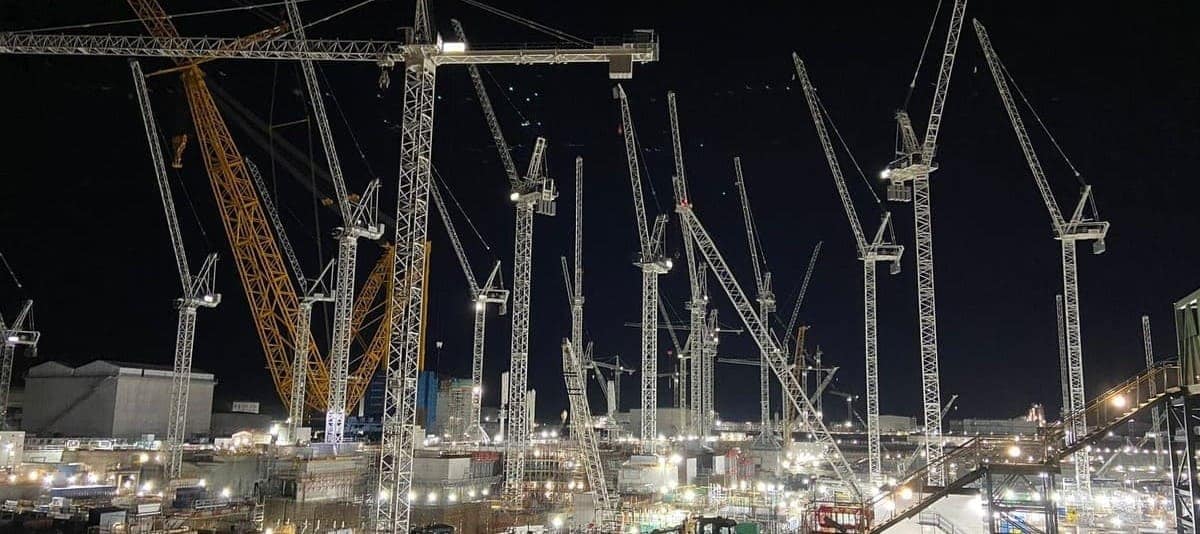
A great example of a crane supervisor’s communication is when high-rise buildings are being built. Usually, a subcontractor does the majority of the framework. This requires multiple trades that work on multiple levels of the building, that need the cranes for multiple lifts.
Some examples of the trades could be steel fixers, carpenters, concrete gangs, steel erectors, electricians, groundworkers, etc. Each trade will have the own supervisor, called a ‘black hat’ because supervisors are recognised by their black hard hats.
Each black hat will contact the crane supervisor to ask for a crane as and when they need a lift.
This can be quite problematic, and can cause arguments, because there are times when lots of black hats want the crane at the same time. So, the crane supervisor needs to be calm but assertive.
3. Coordinating the slinger/signallers.
Once the information has been passed to the crane supervisor, they organise where each slinger/signaller goes and what lift they do in a particular order. Sometimes they will give out a list of lifts and allow the slinger/signallers to organise themselves.
A crane supervisor will also organise when the slinger signallers go on their breaks. This is to rotate them so that, at busy times, there’s always personnel available to use the cranes.
4. Coordinating each crane.
This ties in with the previous section. A crane supervisor organises which crane works with which trade.
They sometimes also coordinate the cranes to make sure they don’t collide.
5. Signing new personnel up to lift plans.
When new to a site, all personnel involved with lifting operations must read and sign up to the lift plan before they do any lifting. So, if a crane supervisor has a new slinger/signaller arrive, they often take them to read through the paperwork and add their signature.

6. Briefing slinger/signallers.
All trades should have a morning briefing before starting work. This is especially the case with the lifting team. A crane supervisor will brief the slinger/signaller on the schedule for the day, or any other important information. This is a chance for them to discuss any problems they have and talk about what can be improved.
Briefings also get done throughout the day if there are any changes to plans.
7. Hiring and firing slinger/signallers.
If a lifting team is short staffed, a crane supervisor will either take new people on or hire them through a superior member of staff.
Also, unfortunately, every company has to let people go, because of a shortage of work, poor employee performance, bad timekeeping, etc. It’s usually the crane supervisor’s responsibility to give the bad news.
8. Checking lifting accessories and equipment for faults.
Lifting operations using cranes is safety critical work, so using equipment that works properly is very important.
It is the crane supervisor’s responsibility to make sure all the lifting accessories are in good working order and don’t have any damages.
Damages or faults could be things like slings that are split, frayed, or stretched; squashed or stretched links on lifting chains, or broken safety catches on chain hooks.
Any faults have to be reported. The item will be disused until repaired, or thrown away if irreparable.


9. Checking the date tags of lifting accessories and equipment.
All lifting accessories have an inspection date. This date gets written on a tag that gets attached to each accessory. The tags must be checked to make sure the inspection date doesn’t expire. If an accessory is out of date, it needs to be taken out of service. All lifting accessories should be inspected via a ‘Thorough examination’ every six months.


10. Ensuring the correct equipment is being used per lift.
Method statements give guidelines on how loads should be lifted and with what accessories. Sometimes, inexperienced slinger/signallers might use the wrong equipment.
For example, slings that have a Safe Working Load limit (SWL) of 3t cannot be used to lift anything above 3t. Or a Shutter that has four lifting points must be lifted using a spreader beam with four chains, rather than two legs of the regular chains.
So, a crane supervisor needs to monitor each lift to make sure the correct equipment is being used.
11. Ensuring the slinger/signallers and crane drivers are working in a safe manner, as per lift plan.
This partly relates to the previous section, in that the crane supervisor makes sure the correct equipment gets used for lifting. But they also make sure the slinger/signallers and crane drivers operate safely.
This could mean things like making sure the driver isn’t driving to fast or erratically, making sure they are listening to their slinger/signallers instructions properly, and making sure the slinger/signallers give the correct information.
12. Monitoring wind speeds.
Wind can be a major problem for lifting operations. Certain things can’t be lifted when specific wind speeds are exceeded. There are also times when all lifting must stop, due to extreme wind conditions.
It’s important to constantly monitor the wind, to ensure that lifting gets done as per the stated wind guidelines in the method statement. This is to prevent incidents or injuries.

13. Recording time allocations of cranes.
It’s like the old saying. Time is money. If a crane supervisor has a crane booked out to them but can’t get it, they will record the amount of time they don’t have the crane for. This is to cover the company if deadlines aren’t met. Sometimes, penalties get charged to them if they go over deadlines.
The types of reasons that stop the company getting the cranes are: other trades using them; crane breakdown; wind-off time, and crane service or thorough inspection.
14. Carrying out lifting operations (if they hold the valid qualifications).
Most crane supervisors are qualified to do the roles of a slinger/signaller. These roles include attaching loads to cranes and communicating with the crane drivers through the lifting operations. However, a crane supervisor cannot carry out lifting operations if they don’t have a valid slinger/signaller qualification.
If they do happen to do the roles of a slinger/signaller, another crane supervisor should be present, because a crane supervisor can’t supervise their own lifts.
Do crane supervisors have to have a slinger/signaller card?
A crane supervisor does not have to have a slinger/signaller card, except when their duties include the roles of a slinger/signaller. In this instance, they must hold the relevant qualifications.
When training, people sometimes do a combined crane supervisor and slinger/signaller course. For example, CPCS provides combined A62 and A40 training.
But mostly, people gain experience as a slinger/signaller before training as a crane supervisor.
Is a crane supervisor the same as a crane coordinator?
A crane supervisor is not the same as a crane coordinator. Although, crane coordinating is a role that is mostly done by crane supervisors.
A ‘role’ is exactly what a crane coordinator is. You don’t need qualifications to do it. The role is given to an adequate person.
The main role of a crane coordinator is to coordinate the cranes so that they don’t get in each other’s way or collide with each other. They also sometimes instruct the slinger/signallers which lifts are being done and when, by which cranes, much like what a crane supervisor does.
How to become a crane supervisor.
As mentioned previously, the most sensible route to become a crane supervisor is to have experience as a slinger/signaller first. This is primary. Another option is to gain experience as a crane operator first.
This way, you get to grips with how lifting operations work. You become familiar with Risk Assessments, Method Statements, and daily briefings. You gain the knowledge and wisdom that only experience gives.
Two governing bodies that provide crane supervisor qualifications are:
- CPCS – (A62)
- NPORS – (N405)
The training can take up to four days, and can cost between £800 – £1400, depending on the course provider.
Click below for your crane supervisor course

As with slinger/signalling and plant operating, a crane supervisor will gain a Red Card, otherwise known as a ‘Trained Operator Card’.


Once you’ve received this card, the next step is to work towards a ‘Blue Card’, otherwise known as a ‘Competent Operative Card’. To obtain this, you’ll need to pass an NVQ Level 2 assessment. This can be paid for by yourself, but some employers will fund it for you. This Blue Card will allow you to work on any site.


The Red Card is valid for two years. Although, a twelve-month extension is sometimes granted. Red Cards cannot be renewed. After expiry, they must be upgraded to a Blue Card.
Click below for your NVQ

SSSTS
Having a Crane Supervisor qualification isn’t always enough. Some sites require a crane supervisor to also hold a Site Supervisor Safety Training Scheme (SSSTS) certificate.
All trade supervisors (black hats) should hold an SSSTS certificate. Although, some like to have the additional Site Management Safety Training Scheme (SMSTS) certificate.
So, as a crane supervisor is in fact a ‘supervisor’, some sites put them in the same bracket.
A SSSTS course usually takes two days. It can cost between £200-£250, depending on if it’s done online or in a classroom.
Conclusion
This article has discussed another important cog in the construction machine. The crane supervisor. It’s a very important role that involves a lot of responsibility and pressure.
It’s important for a crane supervisor to be calm but assertive. They can get a lot of pressure from superiors to get things done quickly. Unfortunately, they also get pushed to do things that are unsafe.
You now know what a crane supervisor is and what the role entails. Hopefully, this will give you some of the tools you need if you want to pursue the role as a career.


Leave a Reply