
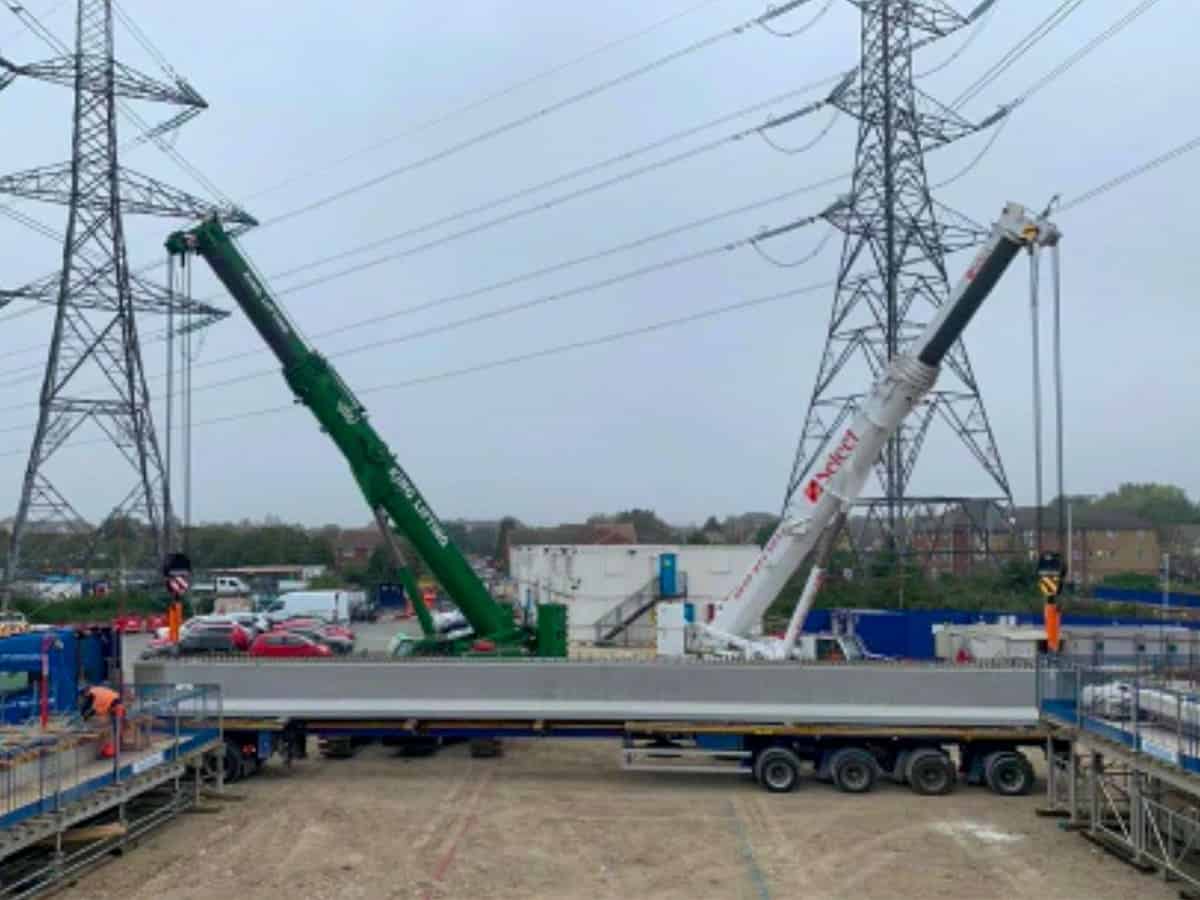
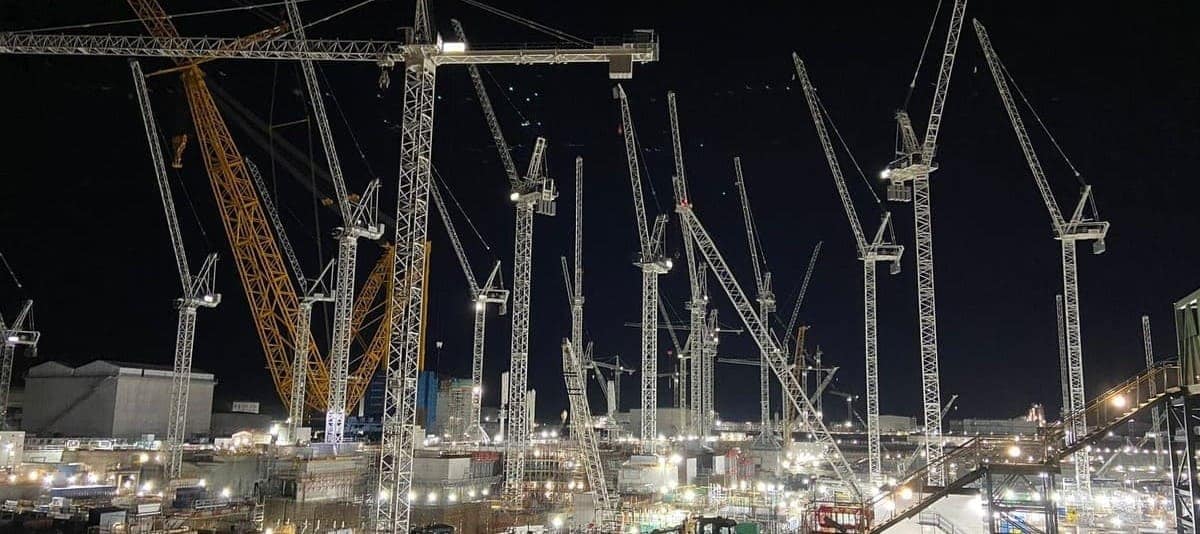
Tandem lifting is a method to lift loads with two or more cranes when the load is too large to lift with one crane.
Why are tandem lifts used?
Crane lifting capacity
Cranes having certain lifting capacities. But throughout the course of a project, there might be the odd lift where a large load exceeds that capacity. Hiring a large enough crane for those big lifts would sometimes cost more than utilising smaller cranes that are used for the majority of the work. Besides, logistics don’t always allow for such large cranes.
Unbalanced loads
Using one crane to lift a very long load could sometimes make the load unbalanced. The pressure would be at the centre of the load, making the weight of the two ends wobble or sway the load. Whereas a crane on either end of the load keeps even stability.
Installing loads at specific angles
When structures are being built, sometimes the components need to be attached at tilted angles. This isn’t always possible with one crane if the load is too large or heavy. One crane can take care of one end while the other crane adjusts the height of the other end to maintain the correct angle during installation.
What are some examples of tandem lift uses?
There are many types of items that would require tandem lifting. One example is for building bridges. Another example is moving ships. As you can imagine, ships can be far too big to lift with one crane. Also, the fuel inside the ship can move around, which imbalances it while lifting. This is why both ends need to be fully supported.
What’s the difference between a tandem lift and assisted lift?
Tandem lift
As explained previously, a tandem lift is a lift done by two or more cranes on a load that is too large or heavy for one crane.
The cranes pick the load up and take it to its destination together. For example, if a large concrete slab is being installed on a bridge, the cranes will install the slab together.

Assisted lift
Assisted lifts, otherwise known as ‘top and tail‘ lifts, are usually used to stand large or long objects up on end. Rather than doing an ‘end lift’, which is where one crane will stand a load up from a laid down position, two cranes lift the load completely off the ground and stand it up together.
Crane 1 will stay in the same position while hoisting the top end of the load up. Crane 2 will slew and/or track to position the bottom of the load underneath crane 1. Then when the load is plum, crane 2 will release all the weight and unhook for crane 1 to take the load away.
This helps to prevent potential snapping of the load. It also keeps the load steady and not swing anywhere, which could happen with an end lift.
Assisted lifts are also done with a tower crane and mobile or crawler crane, because most tower crane manufacturers strongly advise against carrying out tandem lifts.

What are the risks of tandem lifts and assisted lifts?
Side loading
Side loading is a big issue. It’s where sideways pressure is put on the crane’s jib or boom. Cranes are designed to only take downwards pressure. To prevent this, expert coordination of both cranes must be carried out by trained slingers, crane supervisors, and/or crane coordinators.
Cranes colliding
When doing assisted lifts, the crane jibs/booms can get very close to each other. Particularly at the point when the load is almost stood up. This can be very dangerous. If there is contact between the cranes, they should be taken out of service and checked over by engineers.
Here, you see a tower crane hook and mobile crane boom very close to each other while lifting a large panel together as an assisted lift.

Inexperienced personnel and planners
A lot could go wrong during both tandem lifts and assisted lifts. One move in the wrong direction could be fatal.
There is a chain of personnel who need to be competent.
Crane operators need to be experienced. If one crane hoists too quickly or slews in the wrong direction, they could tip the load, bend it, or put too much strain on the crane or accessories.
Similarly, if the slinger gives the wrong instructions, or the supervisor or coordinator doesn’t do their jobs properly, the same catastrophes could happen.
Conclusion
Both tandem lifts and assisted lifts are great ways of utilising the maximum potential of cranes.
However, the lifting industry is a safety critical industry as it is. These types of specialist lifts require extra planning, care, and diligence. The AP responsible for planning these lifts has a lot of responsibility, in terms of choosing the correct cranes and equipment, making sure the lifting personnel are competent, as well as potentially organising exclusion zones and safe areas of work.
Listening is a key factor for all personnel. When multiple cranes are being used, communication can get confusing. Ground personnel switch between speaking to each crane operator. They need to make sure they give the right information to the right operator.
The crane operators have to make sure they carry out the exact instructions given, whether that’s verbal or hand signals. If they’re not sure about anything, they should stop everything and ask.
The moral of the story is, safety is key.
Here is a video explanation with examples of tandem lifting and assisting lifting.
Construction Training & AP Hire
Click on images for details




Leave a Reply