

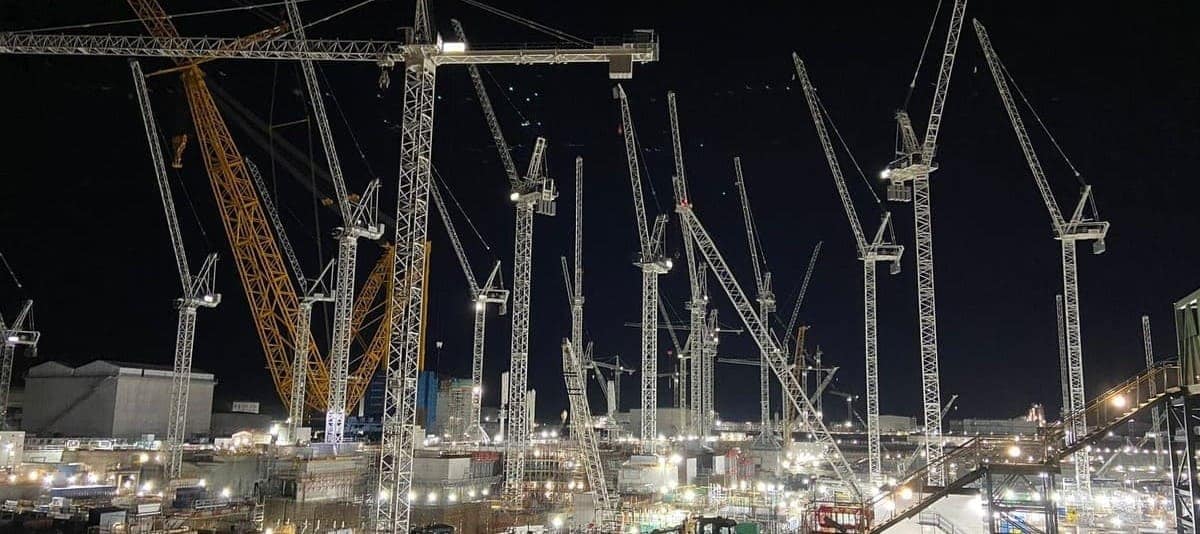
My brother recently visited from Australia. He went out there in 2015 to travel for a year and loved it so much that he decided to stay.

Anyway, while staying at my house for a few days, we were sitting at the dinner table one day chatting about work. He works as a crane operator and piling rig operator. Mid conversation, he threw in that he has a Monday off every two weeks, then carried on about other stuff as if it’s nothing.
‘Woah’, I said. ‘You do what? A day off every fortnight? How does that work?’
‘Yeah, it’s an RDO’, he replied. ‘Everyone in construction gets them.’
I couldn’t get my head around this. It sounded fantastic. So I interrogated him. The interrogation blew my mind, so I did some research. This is what I learnt.
What exactly is an RDO?
An RDO is a Rostered Day Off. There are various ways of earning this day off, depending on the area, the union, and the EBA (I’ll get to that in a minute). One way of earning the RDO is by banking extra hours across the working week.
The idea is simple. Most construction workers in Australia are employed on a 38-hour week. Rather than working 7.6 hours a day, they work eight. Those additional minutes accumulate, and once enough hours are saved, they are taken as a paid day off, usually every fortnight.
Another method, which is the case for my brother and his colleagues, is that the company deducts 4 hours of wages from the day taken off.
Victoria, where he is based, is one of the most unionised and tightly regulated construction markets, so the RDO is forced. The pattern is set in advance through a published RDO calendar, agreed by industry bodies and the CFMEU.
Victoria hosts stronger unions than other areas, like New South Wales. The RDO is not forced there, so workers often choose to bank it rather than take the day off.
What is the CFMEU?
The CFMEU (Construction, Forestry and Maritime Employees Union) is one of Australia’s most powerful unions and has played a defining role in shaping working conditions in construction. Through collective bargaining agreements known as EBAs (Enterprise Bargaining Agreements), it negotiates wages, safety standards, and site conditions across the sector. The RDO calendar is one of its most visible achievements.
Some employees opt out of their company EBA and choose the union organised contract. Also, New South Wales uses this agreement as a basis across the board, but workers can add to it or amend certain items.
Each year, the CFMEU Victoria and Tasmania branch releases an official RDO calendar showing which Mondays will be taken as Rostered Days Off. The dates are often arranged to create long weekends around public holidays or to coincide with quiet seasonal periods. Employers and subcontractors across the state align their schedules accordingly.
The system has obvious benefits. For workers, it offers predictable rest, improved work-life balance, and reduced fatigue. For employers, it provides a structured way to manage site closures and downtime. In a physically demanding industry where long hours and safety risks are constant, the RDO system has become an integral part of the cultural rhythm of construction work.
RDOs beyond the building site
While construction is the most visible example, RDOs are not unique to that industry. Variations of the same concept exist across other Australian sectors where employees work set weekly hours under an award or enterprise agreement.
Manufacturing and engineering companies often use a 19-day month, where staff work slightly longer days and receive one RDO every four weeks. Local councils offer similar arrangements for outdoor maintenance and waste collection teams. Public-sector agencies sometimes run a nine-day fortnight scheme, particularly in technical or field service roles.
The principle remains the same. Workers average 38 hours a week, but through small daily surpluses they earn regular paid days off. In some industries, such as construction and community services, these entitlements are even portable, meaning accrued service follows the worker between employers within the same sector.
Is there payoff?
To a British ear, the system sounds like a dream. A guaranteed extra day off every fortnight, negotiated by unions and hardwired into the industry calendar. Yet in Australia, this isn’t a novelty. It’s a long-established feature of the construction industry and one of the country’s most distinctive workplace practices.
Both of these points line up with 1) Why I stopped my brother in his tracks when he mentioned it, and 2) Why he almost skipped past the subject.
But are there any downsides? Let’s start by comparing with the UK.
The UK’s approach reflects broader cultural and legal differences. British employment law prizes flexibility and decentralisation. Employers and workers negotiate schedules individually, rather than through national awards or enterprise agreements. Union influence, while still significant in parts of the public sector, is weaker and more fragmented than in Australia.
This flexibility allows some workers to compress their hours or take flexi-days.
With this in mind, would it be more difficult to have that flexibility in Australia? Work from home days, part-time hours, shooting off for appointments, etc. These could all be problematic.
This flexibility issue extends to employers. The system does have its critics among employers. Some occasionally argue that industry-wide RDO calendars limit flexibility and increase project costs. Yet for many workers, the system represents a rare example of industrial coordination that prioritises wellbeing and predictability over raw efficiency.
What about the 4-hour wage deduction? With the current global cost of living at an all-time high, people might struggle when losing that 4 hours money. One alternative is to negotiate working extra hours on other days instead. But what if their colleagues don’t do those hours? And what if working extra hours accumulates to fatigue. That kind of defeats the object of the RDO.
Another option is to work in areas where there are looser regulations, and bank the days off. However, that might mean working away from home, working more hours than is healthy, and/or relocating. The problem is these solutions contribute to the mental health epidemic in construction. With construction being the industry with the highest suicide rates, I know what option I’d rather. Australia seems to have come up with a perfect solution to the dilemmas many of us face in construction.
But what else does Australia do that we don’t?
Long Service Leave
If RDOs show how Australia manages short-term rest, Long Service Leave (LSL) reveals its approach to long-term loyalty. Unique to Australia and New Zealand, Long Service Leave grants employees a paid break after extended continuous service, typically eight to ten weeks after ten years with the same employer.
The policy dates back to the 19th century, when colonial administrators were allowed extended leave to return to Britain after years of service. Over time, the benefit spread to other workers and became embedded in state legislation. Today, every Australian employee is entitled to it, and in some industries the entitlement is portable, meaning years of service accumulate across different employers within the same sector.
Lessons for the UK
Could Britain adopt something similar? In theory, yes. The mechanics of an RDO system are straightforward. Slightly longer days balanced by a regular rostered day off. Many British workers already do this informally, whether through compressed hours, flexi-time, or TOIL (Time Off in Lieu). The difference is scale and consistency.
If adopted broadly, an RDO-style calendar could help address fatigue, mental health, and productivity issues in physically demanding sectors such as construction, healthcare, and transport. Regular, predictable rest improves safety and morale, while the collective scheduling avoids the coordination chaos that can arise when staff take individual days off.
However, implementing such a system in the UK would require stronger sector-level bargaining and cultural change. Without national awards or powerful unions coordinating conditions, RDOs would likely remain piecemeal initiatives rather than a national standard.
Final thoughts
The RDO is a small but telling example of how cultural and industrial frameworks shape working life. Where Britain prizes flexibility and individual negotiation, and America emphasises productivity and contractual freedom, Australia has institutionalised rest.
For construction workers in Victoria for example, that means waking up every second Monday to scenarios such as a quiet house, quality family time, appointments that are otherwise difficult to make, and not to mention a well-earned long weekend. For the rest of us, it might be a model worth watching. A simple recalibration of hours that acknowledges what most of us already know instinctively. That good work needs good rest.
Construction Training
Click on images for details



Leave a Reply