
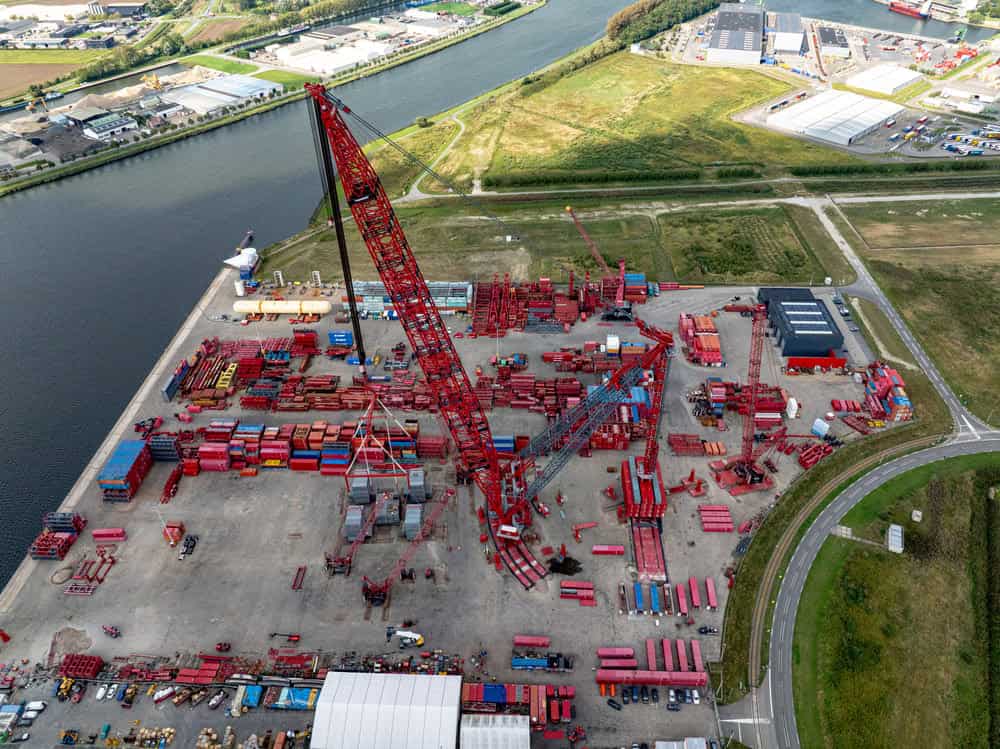
The Mammoet SK6000 has arrived as the strongest land-based crane in the world, overtaking Sarens’ SGC-250, and represents a significant step forward for the heavy lifting and modular construction sectors. Designed to meet the demands of fast-growing industries such as offshore wind, FPSO (Floating Production Storage and Offloading) construction and large scale energy infrastructure, the SK6000 brings a combination of strength, reach and sustainability.
With a maximum lifting capacity of 6000 tonnes and the ability to lift 3000 tonnes to heights of around 220 metres, the SK6000 is engineered for projects where conventional cranes simply cannot perform. As components used in offshore and energy projects continue to grow in scale, this crane is positioned to solve several bottlenecks related to capacity, reach and efficiency
One of the most prominent forces shaping the heavy lift market is the rapid increase in the size of industrial components. Wind turbine towers, nacelles and monopiles have steadily grown as developers push to increase power output. FPSO and FLNG (Floating Liquefied Natural Gas) modules have also expanded as operators seek greater operational efficiency and improved production capacity. As components grow, they often outpace the lifting equipment available. Simply put, the cranes are not big enough to cope.

This is where ring cranes like the SK6000 come to the rescue. With a load moment of 510000 tonne metres and exceptional stability from its central ballast system, it gives contractors the freedom to design and use larger modules. This supports the wider movement towards modularisation, where heavy industrial projects are built around fewer but larger preassembled units. This approach shortens schedules, reduces risk and lowers costs.

Specifications
The SK6000 is designed around Mammoet’s proven ring crane concept but pushes the limits of what is possible with land-based lifting. Key technical features include:
- Maximum lifting capacity – 6000t
- Load moment – 510000tm
- Ballast weight – 4200t
- Maximum ground bearing pressure – 30t/m²
Traditional ring cranes require a full circular ring track that the ballast weight travels on. This often takes up considerable space. The SK6000, however, places its ballast in the middle and rotates around it, which reduces the footprint by half, freeing up working space on site and reducing the amount of temporary ground preparation required.
The crane also includes a fully electric power option. It can operate from large battery packs or draw power from the grid where available, allowing contractors to reduce emissions and fuel consumption on large industrial sites. A major benefit in sectors that are increasingly required to demonstrate lower carbon construction methods.
Mammoet SK6000 Crane Specifications
| Specification | Value |
|---|---|
| Maximum lifting capacity | 6000 tonnes |
| Typical lift height at 3000 tonnes | 220 metres |
| Load moment | 510000 tonne metres |
| Central ballast weight | 4200 tonnes |
| Maximum ground bearing pressure | 30 tonnes per square metre |
| Power source | Electric or battery powered operation |
| Transport | Fully containerised components |
| Mobility | Self propelled, no crawler support required |
The Offshore Wind Sector
The offshore wind industry is entering a new era of scale. Turbines with rotor diameters approaching 300 metres and towers well over 150 metres tall require stronger lifting solutions for both construction and maintenance. Existing land-based cranes and many floating solutions struggle with the sheer height and weight of the latest components.
Mammoet believes the SK6000 is ideally suited for marshalling yards, port construction zones and heavy lift terminals that support offshore wind fabrication. With the ability to lift extremely heavy components at significant radius, the crane can preassemble taller tower sections, larger nacelles and heavier transition pieces. This streamlines logistics before final offshore installation. The growth of floating offshore wind will also benefit from this capacity. Floating structures are larger and heavier than bottom fixed equivalents and require major lifting capability during assembly.
Unlocking New Efficiencies in FPSO and FLNG Construction
FPSO and FLNG vessels rely heavily on modular construction. Topsides are often built from preassembled units that can weigh thousands of tonnes. However, traditional heavy lift cranes struggle to handle the heaviest of these modules, which forces engineers to split modules into numerous smaller units. This increases interfaces, welding time, testing requirements and schedule complexity.
Mammoet’s own white paper on FPSO profitability highlights that larger modules would deliver major cost and schedule benefits, but the lifting equipment historically has not allowed it. The SK6000 changes this dynamic. Its capacity and reach allow shipyards and fabrication yards to design more efficient modules, meaning larger units can be lifted directly onto the hull. This reduces construction hours; the amount of transportation vehicles; on-site and logistic operational risks; and disruption, which subsequently has a positive impact on the carbon footprint, cost, as well as health and safety.
Applications Across Energy and Infrastructure
Beyond offshore wind and floating production systems, the SK6000 is positioned to support several other strategic sectors.
Nuclear – Modular nuclear plant construction is becoming more common, particularly in new build and refurbishment projects. The ability to lift large, preassembled reactor modules or containment structures can simplify construction sequences and reduce time on the critical path.
Petrochemical and Industrial Plants – Large refinery or process plant modules can be fabricated off site and transported in fewer pieces. This reduces on site labour and helps maintain quality control during assembly.
Bridge Building and Major Infrastructure – Ultra heavy segments such as bridge girders, tunnel components or lifting frame assemblies can be placed with minimal reassembly or temporary works.


Engineering Behind the Machine
The SK6000 builds on decades of Mammoet ring crane development. The company’s SK series already includes several cranes that have worked on some of the most demanding lifts in the world. The SK6000 pushes this experience further with improved winch systems, a redesigned ring arrangement and an updated control system.
Key mechanical systems are supplied by industry leaders including Liebherr, which provides high performance winches with exceptional line pull capacity. This ensures smooth, controllable lifting, even under extreme loads.
Every part of the crane is designed for containerised shipping. This allows the crane to be transported more easily across continents. For a crane of this scale, global mobility is a major advantage. Major projects are not always located near the companies best equipped to deliver them. A crane that can be moved efficiently helps close this gap.
A More Sustainable Heavy Lift Solution
The construction sector is under increasing pressure to reduce emissions. Heavy lifting machinery is traditionally diesel powered and often operates for long periods at high load. Mammoet’s decision to create a crane capable of full electric operation is an important step for the industry.
Using grid power or battery power means quieter operation, reduced site pollution and a lower carbon footprint for major project lifts. When combined with modularisation strategies that reduce the number of individual lifts, the sustainability benefits increase even further.
Looking Ahead
Although the SK6000 has been launched and is ready for commercial deployment, as of now in late 2025, it’s yet to land on its first project. When it does, the SK6000 will influence how future industrial projects are designed. Engineers will have the opportunity to think bigger. Module designers will have fewer restrictions on weight and radius. Contractors will gain more flexibility in scheduling and site layout. Owners may gain shorter construction timelines and reduced risk.
The SK6000 represents a shift in how heavy lifting is approached. It removes long standing constraints and encourages new thinking in modular construction. As the scale of energy and infrastructure projects continues to grow, this crane will help define the next generation of heavy industry.


Leave a Reply