

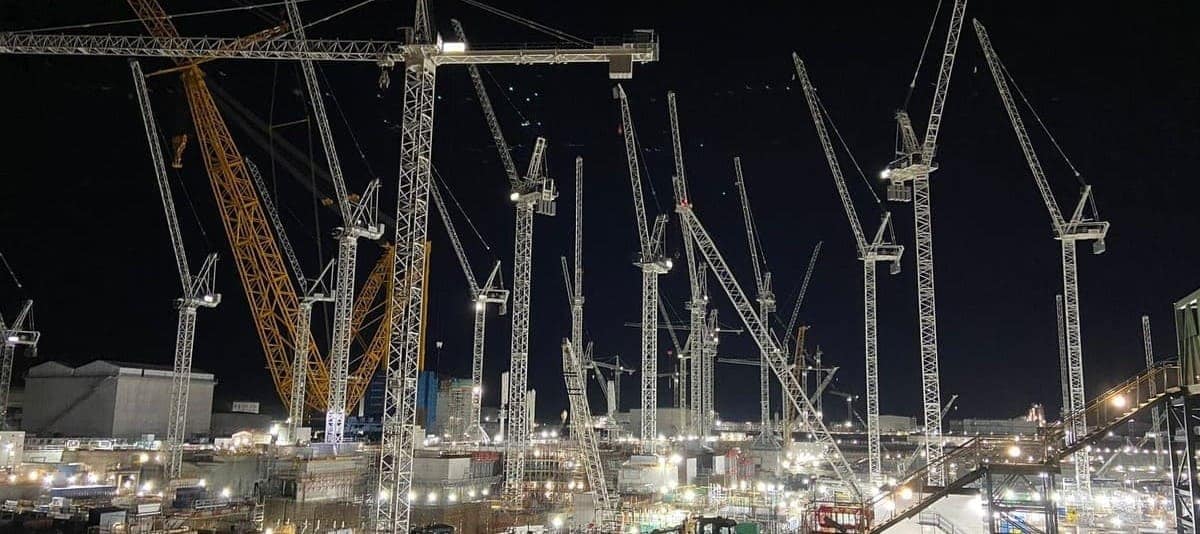
There are lots of different types of cranes. But tower cranes play a major part of the construction industry. There are two types of tower cranes. Ones that have luffing jibs and ones that have saddle jibs.
What’s the difference between the two? Here we’ll start with the simple answer.
A luffing jib is a jib that lowers and raises at one end. The bottom end attaches at a fixed point using a pin. And a saddle jib is fixed in a horizontal position.
Now let’s get into a little more detail.
Luffing Jib

Tower cranes that luff are commonly known as ‘luffers’. Luffing is the up and down motion of the end of a jib, like a lever. The jib moves in an arc of almost 90 degrees.
The bottom end of the jib rotates on pins that fix it to the crane.


The top end’s tension is held up by a luffing rope that travels through a pulley system and is fed by a luffing drum.
As the crane operator jibs up, the drum, with the rope wrapped around it, turns to pull the rope onto itself. This shortens the rope from the drum to the end of the jib, which raises the jib. The reverse gets done to lower the jib.

Luffers are the most common of the two types of cranes for a few reasons.
Here are the pros:
- Luffers take up less airspace than a saddle jib.
This is useful for keeping the load inside site boundaries. Especially on sites that have small footprints. There can be heavy fines when a load over-sails into public areas or over other properties.
2. They’re useful on multi-crane sites, where there is little space between the cranes.
Cranes working close to each other can be very effective. To avoid colliding with each other when slewing, cranes can jib up and slew round to get out of each other’s airspace.
This also helps to avoid the cranes over-sailing each other with loads attached.
3. They give the crane extra height.
Because of the upwards angle, the jib can raise above obstacles without having to erect the crane mast higher than necessary. This reduces the cost of mast hire.
4. They can be used on other types of cranes.
This ties in with the previous point. The fact that luffing jibs can go a lot higher than the actual body of the crane means that they can be used for cranes on the ground.
Lots of mobile cranes, like crawlers, rough-terrain cranes, telescopic cranes, etc, use luffing jibs. They have the ability to move around on the ground and be able to reach the jib up to great heights.
Because of this, mobile cranes often get used to erect tower cranes.

5. Although more rope is needed, luffers give more height. So, if the crane is working on the roof of the building, which is at the same level or higher than the cab, there is still enough hoist rope to carry out lifts. This is especially useful if installing columns that might be tall.
However, if the crane needs to jib down to maximum radius, the height problem will still occur, because the jib will be almost horizontal. Therefore, less hoist rope will be available to clear the roof.
As much as luffers have their good points, there are some downsides.
Here are the cons:
- They’re usually more expensive to run and hire.
The luffing action uses more energy than a saddle jib. The extra mechanics means there is more risk of both failure and wear-and-tear. This means hire companies need to charge more.
2. They take longer to erect and dismantle.
The extra mechanics make up more components. This equates to more labour.
3. They’re slower than saddle jibs to increase and decrease the radius.
The luffing action is slower than the trolley action of a saddle jib. This isn’t necessarily a bad thing, because slow means steady and safe. But it also means more difficulty catching a jib swing.
4. More hoist rope is needed.
Because the jib gets raised to almost vertical, much more hoist rope is needed. The hoist rope has to travel from the drum on the back jib, up the full length of the jib, then down (sometimes the full length of the jib again), to the hook block.
So, a crane that is 100m tall with a 50m jib would need an extra 50m of hoist rope than what the same configuration of a saddle crane would.
To summarise:
Pros
- They use minimal airspace.
- Useful for avoiding colliding with or over-sailing other cranes.
- They give extra height.
- Can be used on other types of cranes.
- Allows more height for the loads.
Cons
- Usually more expe nsive to run and hire.
- Can take longer to erect and dismantle.
- Slower to increase and decrease the radius of the hook block.
- Needs more hoist rope.
Saddle Jib

Saddle jib cranes are also referred to as saddlebacks, hammerheads, topless or flat tops, A-frames, or just saddles for short.
Saddle jibs don’t have moveable ballast weights using swivel arms like some luffers do. They consist of a horizontal back jib that holds the drums, ballast, motors, etc, and a horizontal front jib that a trolley runs along. The trolley takes the hoist rope and hook block to the relevant destinations.
This jib rests flat on top of the slew ring and mast. It makes the crane look similar to a ‘T’ shape.
There are differences between A-frame and topless/flat top cranes. An A-frame is a triangular frame on top of the crane, consisting of wire ropes on either side that take the tension of the front and back of the jibs. Whereas, on a topless/flat top crane, there’s nothing on top of the crane jib. It’s completely flat.


Although luffers are more common, saddle cranes do have their uses.
Here are the pros:
- They can cover a larger area than luffing jib tower cranes.
Because of the configuration and physics, the jibs on saddleback tower cranes can generally be longer than the ones on luffing tower cranes. This means they’re more able to cover larger areas.
2. The radius of the hook block can change quickly.
Where luffers have to move the whole jib to change the radius, saddles only need to move the trolley that runs along the underside of the jib. The trolley moves much faster than what a jib can.
This is useful for very busy sites with tight deadlines. It also makes catching a jib swing easier.
3. They’re able to over-sail other cranes if needed.
A lot of multi-crane jobs use cranes that are of different heights. So, instead of each crane bringing the jibs up to avoid one another, like luffers need to, a taller saddle-jib crane can sail over a shorter one, as long as the trolley decrease its radius to avoid the ropes or load colliding with the other crane.
Under special circumstances, some sites even allow loads to get lifted over the top over other cranes. Particularly where the crane bases are at different levels, like in deep basements. This would be more difficult with luffers, because the lower crane’s jib could raise into the higher crane’s air-space.
4. They’re cheaper to run and hire.
Because a trolley is much smaller and lighter than a jib, moving it uses less power. This is cheaper in the long run.
There are also fewer mechanical parts, which means less maintenance and less cost.
5. They’re usually quicker to erect and dismantle.
Again, because there are fewer mechanical parts, a saddle jib crane should take less time to erect and dismantle than a luffer of the same height.
6. Needs less hoist rope.
Because the jib lays horizontally, less hoist rope is needed to run from the jib down to the hook block than a jib that’s raised up.
Here are the cons:
- The cranes need more height to get over the top of obstructions.
Because the jib is fixed in a horizontal position, rather than raising up, the crane itself might need to be higher to avoid buildings, other cranes, or any other obstruction. In this instance, more tower sections are needed, which is more cost.
2. They can rock and sway more.
Jibs that lay horizontal are more susceptible to catching cross winds. These winds can rock the crane, making driving them quite difficult.
Also, physics makes them a little less stable. Imagine your arm held out straight again, with weight in your hand. If you swing the arm around, it would be harder to control and stop than it would if your arm was close to your chest.
This can also be the case for luffers when the jib is at maximum radius. But most lifts happen at closer radii where the jib is easier to control.
3. They can collide with obstructions easier.
Being in fixed positions, saddle jibs can’t move to clear themselves of obstructions like luffing jibs can. So, the mast has to be tall enough to give the jib plenty of clearance.
4. Less hoist rope is available.
This ties in with the previous point. Because the jib doesn’t raise up, this doesn’t allow for extra height for lifting. This can cause problems when lifting very tall objects on the highest level of a building.
This also makes catching a swing more difficult. Loads swing faster and more erratically when the load is right up underneath the jib. It’s hard for the driver to control. Plus, it’s hard for people holding onto the load to manage.
5. They’re less versatile.
Unfortunately, saddle jibs aren’t practical to go on cranes that work on the ground. Any mobile crane works better with luffing jibs, because they can get more height.
To summarise:
Pros
- They usually cover a larger area than luffers.
- The hook radius can change quickly.
- They can over-sail other cranes if needed.
- Cheaper running and hiring costs.
- Usually quicker to erect and dismantle.
- They need less hoist rope.
Cons
- The cranes need more height to get over the top of obstructions.
- They can rock and sway more.
- They can collide with obstructions easier.
- There is less hoist rope available. Hence, less height to play with.
- They’re less versatile.
Conclusion
As you can see, there are advantages and disadvantages to both types of jibs. These things are useful to know if you’re new to crane driving and slinger/signalling.
Ultimately, the type of jib and crane configuration to use is decided by the lead Appointed Person (AP).
Lots of things get taken into consideration when planning what type of cranes to use. Here are some of them:
- The average load weight throughout the job.
- The heaviest load to be lifted throughout the job.
- What obstructions are nearby and how tall they are.
- If there are railway lines next to the job.
- The height of the buildings or structures to be worked on.
- The floor area of the site.
- The contractor’s budget.
- How many cranes are needed.
- If one crane is needed to erect or dismantle another crane.
Hopefully, this has given you a good understanding of the differences between the two types of jibs, what they’re both used for, and what decisions are made to choose such jibs.
If you have any questions, please comment below. And I ask that you kindly share this article. The more people with as much knowledge about the industry as possible, the better.
Construction courses and AP hire
Click on images for details




Leave a Reply