
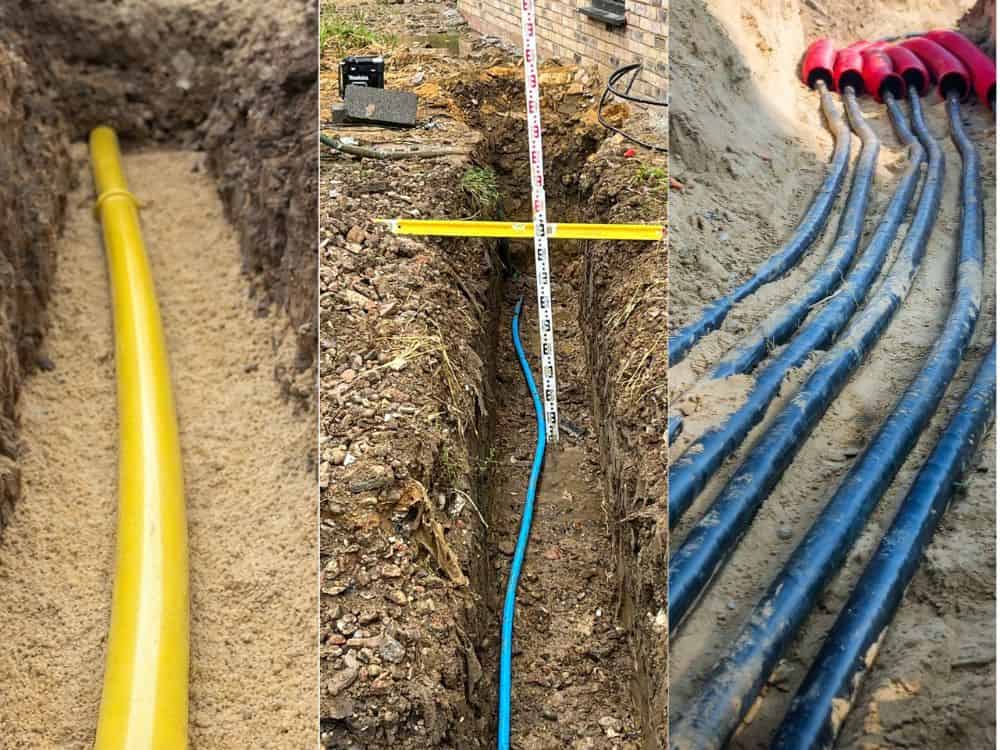
When installing underground utility services, getting the trench depth right matters more than many people realise. Gas, water and electricity supplies all need enough cover to protect them from damage, reduce the risk of future strikes and keep maintenance straightforward.
There isn’t a single rule that covers every situation, but there is well-established UK best practice. The guidance below reflects what is typically used on domestic and light commercial projects and should be seen as practical advice rather than a rigid specification.
General Principles for Utility Trenches
Utility trenches should be excavated with a firm, level base and stable sides. The bottom of the trench needs to be free from stones, rubble and sharp material that could damage pipes or cables once they are laid.
Where work takes place near existing services, it’s also important to follow recognised safety guidance such as the HSE’s advice on avoiding danger from underground services (HSG47), which sets out safe working practices for excavation and service installation.
Where possible, services should be installed at consistent depths, laid on suitable bedding and clearly identifiable once backfilled. If more than one service is present, they should be installed with enough separation to allow for safe future work without unnecessary risk.
Gas Pipe Trench Depth
Gas services are usually laid shallower than water pipes but still need careful installation due to the obvious safety implications. The depth required depends largely on where the pipe is running, with additional cover needed under driveways or other trafficked areas.
In most domestic situations, gas pipes are typically laid with around 375 mm of cover, increasing to around 600 mm where the service passes beneath driveways or other trafficked areas.

Good bedding and careful backfilling help prevent movement, while clear identification above the pipe reduces the risk of accidental damage during later excavation.
Gas pipes should be fully surrounded with fine, selected material and backfilled carefully.
| Requirement | Typical UK Practice |
|---|---|
| Minimum cover in soft ground | 375 mm |
| Cover under driveways or trafficked areas | Up to 600 mm |
| Bedding material | Fine sand or pea shingle |
| Bedding thickness | Approximately 50 mm |
| Warning tape colour | Yellow |
| Sleeving through structures | Required |
Water Pipe Trench Depth and Frost Protection
Water services are installed deeper than other utilities to reduce the risk of freezing. This becomes particularly important in exposed locations or areas where ground temperatures can drop significantly during winter months.
Water pipes are commonly installed at a minimum depth of around 750 mm, with greater cover used in exposed or rural areas to provide additional frost protection.

In some situations, insulation is used, but this should be treated as an additional safeguard rather than a replacement for adequate burial depth.
| Requirement | Typical UK Practice |
|---|---|
| Minimum cover depth | 750 mm |
| Recommended depth in exposed areas | Up to 900 mm |
| Bedding material | Sand |
| Bedding thickness | 50 mm to 100 mm |
| Warning tape colour | Blue |
| Sleeving through structures | Required |
Electricity Cable Trench Depth and Safety
Electricity cables need both sufficient cover and physical protection to reduce the chance of damage during future digging. Trench depth is mainly influenced by location, with greater cover required where cables pass under paths, driveways or other areas subject to loading.
For domestic installations, electricity cables are usually buried at around 450 mm in gardens, increasing to around 600 mm where they run beneath paths or driveways.

Cables are typically laid on sand bedding, protected with tiles or slabs above, and clearly marked with warning tape to alert anyone excavating in the future.
| Requirement | Typical UK Practice |
|---|---|
| Minimum cover in gardens and soft ground | 450 mm |
| Cover under paths and driveways | 600 mm |
| Bedding below cable | 50 mm sand |
| Sand surround above cable | 50 mm |
| Mechanical protection | Cable tiles or slabs |
| Warning tape colour | Red |
Does Cable Size or Voltage Affect Trench Depth?
For most domestic installations, trench depth is determined by where the cable is installed rather than its size or voltage. A larger domestic supply cable will generally be laid at the same depth as a smaller one if both are installed in similar ground conditions.
Different requirements apply where high-voltage cables are involved, where cables are owned by the local distribution network operator, or where multiple cables share the same trench. In these situations, the relevant authority’s specification should always be followed.
Much of the accepted UK best practice around the positioning and identification of underground services is reflected in guidance published in the Street Works UK (formerly NJUG) guidance on underground utilities positioning and colour coding (Volume 1).
Separation Between Utility Services
Where more than one utility runs in the same trench, adequate separation is needed to allow safe installation and future maintenance. Crossings should be kept to a minimum and clearly recorded.
As a general guide, a separation of around 150 mm is typically maintained between services, both horizontally and where services cross.
| Situation | Typical Minimum Separation |
|---|---|
| Horizontal separation | 150 mm |
| Vertical separation at crossings | 150 mm |
| Preferred service order | Electricity above gas and water |
Backfilling and Reinstatement
Before backfilling, it’s good practice to check that each service has been installed at the correct depth with the appropriate bedding and protection in place. Selected material should be used around pipes and cables, taking care not to apply heavy compaction directly above them.
Once complete, surfaces should be reinstated to match the surrounding area. Keeping photographs before backfilling can be helpful if services need to be located again in the future.
Final Thoughts
There’s no single trench depth that suits every situation, but following accepted UK practice goes a long way towards reducing risk and avoiding problems later on. When in doubt, it’s always worth checking requirements with the relevant utility provider before work starts.
And remember, care must be taken when digging the trenches. A survey scan should be taken of the area prior to excavation to help prevent damaging existing services. It’s easy for diggers to cause such damage without the operator realising. Especially in hard or rubbly ground.
Construction Training & Services
Click on images for details



Leave a Reply