

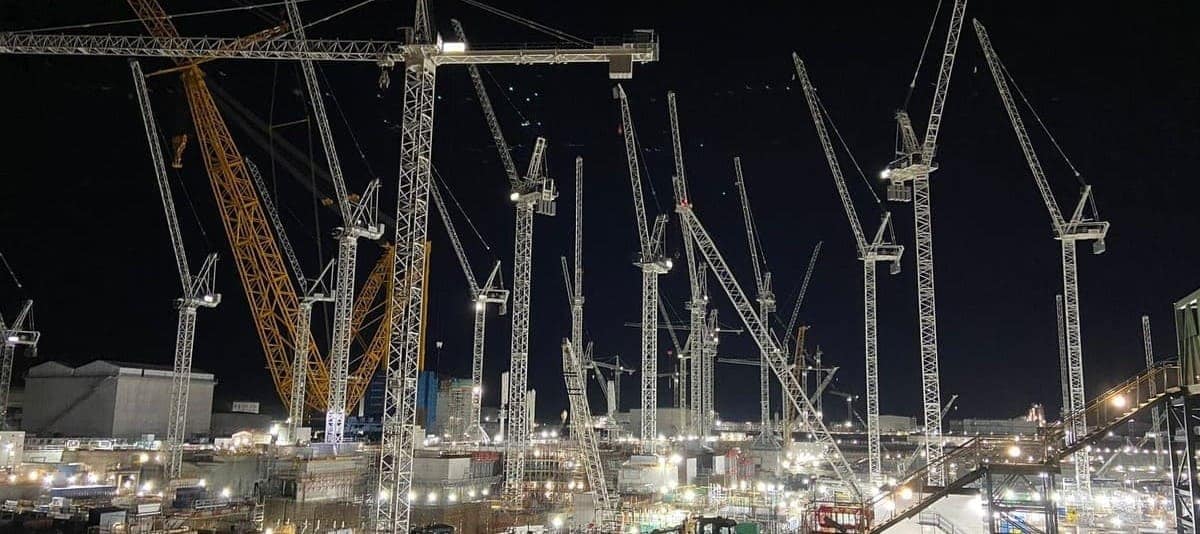
Crane operating is a safety critical role. Starting a career in the field takes serious consideration.
There are stages to become a fully qualified crane operator. Follow the step-by-step stages below.
How to become a crane operator
Stage 1 – Health & Safety touch screen test
To be eligible to operate cranes, all applicants must have undergone a Health and Safety touch screen test within two years prior to training. This is to ensure personnel can show that they’re able to work safely.
There are three categories of HS&E tests and subcategories within those categories:
- Operatives
- Specialists
- Managers and professionals
A tower crane operator will need to do a specialist work at height (WAH) test in addition to covering five core knowledge areas included in the Operatives test.
Stage 2 – Training
The two main bodies that provide crane operator certification are:
Construction Plant Competency Scheme (CPCS) and National Plant Operators Registration Scheme (NPORS). NPORS is not as widely recognised as CPCS.
Some construction sites don’t accept NPORS accredited operators. Which is why CPCS is usually the preferred option, even though it tends to be more expensive.
The length and prices can vary depending on the course provider and the type of crane. The courses are usually anywhere between five and ten days. And they can cost between £1500 – £3500.
Rather than training directly with a provider, another option is to apply for in-house training with a crane company or contractor. In-house training could be by way of a Lifting Technician Apprenticeship, where the employer funds all the training. Or an employer could pay for the course, then the employee pays them a small amount out of each wage packet.
Click below for your discounted crane course

Category codes
Here are the codes for each crane category that should be looked for when choosing which course to do:
CPCS Category Codes
Tower crane – A04
- A04A – Trolley Jib – Cab controlled
- A04B – Luffing Jib – Cab controlled
- A04C – Trolley Jib – Remote controlled
Crawler crane – A02
Mobile crane – All duties – A60
Compact crane – A66
- A66A: Compact Crane – Static Stabilisers
- A66B: Compact Crane – Mobile Stabilisers
- A66C: Compact Crane – Luffing Static Duties
- A66D: Compact Crane – 360 Pick and Carry
NPORS Category codes
N102 – Tower crane
N103 – Crawler crane
N101 – Mobile crane
N140 – Compact crane
Mobile cranes
Mobile cranes are slightly different, because they’re driven on public highways. An extra driving licence is needed for this. An HGV Class 2 (CAT C).
Stage 3 – Red Card & Blue Card
Upon passing a course, an operator gains a Red Card (Trained Operator Card).

This card is valid for two years to allow the operator to gain enough experience to advance to a Blue Card (Competent Operator Card). In some cases, a year extension can be applied for before gaining the Blue Card. But this can happen only once.
To obtain a Blue Card, operators get assessed to gain an NVQ or SVQ relevant to the card category. This Blue Card is valid for five years, after which, a touch screen module has to be undertaken. This card can be renewed as many times as required.


Both CPCS and NPORS provide their own versions of red and blue cards. But once an operator gains one, they can’t interchange it to the other.
Come to use to progress to the next level in your career.
Our experienced NVQ assessors understand that this step represents a significant career milestone. They work closely with candidates to ensure you’re fully prepared and confident throughout the assessment process. Rather than simply testing your knowledge, they provide ongoing guidance and support, helping you demonstrate your competence effectively while building on the skills you’ve developed in the field.
The assessment focuses on real-world scenarios you’ll already be familiar with from your day-to-day work as a Red Card holder. Our assessors take a collaborative approach, working with you to showcase your abilities and ensure you’re ready to take on the role of a crane operator.
Click on the image below to choose your assessor. They will support your journey to Blue Card certification.

How much can crane operators earn?
Crane operators’ earnings vary greatly depending on many factors, like their experience, job location, sector they work in, and the crane category.
For example, London and Southeast England salaries are usually higher than other areas in the UK because of the differences in the cost of living.
So, let’s give some rough ideas.
Salary breakdown
Entry level – £20k – £30k
Crane operators with the least experience fall into this category. They could hold Red Cards or be in an apprenticeship. They could work for small companies on small contracts. They could even work in areas where the overall wages are lower because of the lower cost of living.
Experienced – £30k – £55k
Blue Card operators with a few years of experience could expect this as a basic salary. They would be experienced enough to operate larger cranes and work on more complex projects.
Specialist – £60k+
Highly experienced operators who work with unusual cranes or within specialist fields are usually in the higher wage bracket. But they may have to do extra training to gain qualifications in their specialist fields. Such as the oil and gas industry, for example.
Freelancers/Contractors – £300+ per day
These are crane operators that are not employed by a company. They can work on sort-term contracts. They might even be owner-drivers, where they own the crane that they operate and charge for the crane and labour. The rates can vary greatly, but these operators can request higher rates.
Overtime – Bear in mind, these are all based on basic salaries. Most crane operators are required to work unsociable hours, which could mean lots of overtime. Depending on the pay structure, operators could increase their income by 70-80% with overtime.
Do crane operators need qualifications?
Crane operators don’t need academic qualifications prior to training. Although, some employers that provide apprenticeships might request maths and English GCSEs.
The only qualifications employers demand before hiring are the relevant crane certificates applicants gain upon passing their crane training.
What attributes does a crane operator need?
It’s one thing to be a crane operator, but being a ‘good’ crane operator requires lots of skills and attributes, like (but not exclusively to):
- Great listening skills
- Safety consciousness
- Great team player
- Patience
- Calmness under pressure
- Spatial awareness
- Good eyesight (or suitable prescription glasses)
- Methodical thinking
- Resilience
- Assertiveness
- Good people skills
- Hand-eye coordination
- The desire to learn and develop
- Integrity
Conclusion
Because crane operating is a safety critical role. Only people who have safety as their priority should pursue the career.
There are plenty of options available in terms of what type of crane to train for. So, would be operators should research the category that best suits their requirements. For example, someone who is terrified of heights might not be best suited to operate tower cranes. Or somebody who gets nervous driving on roads might not want to drive mobile cranes.
There are also lots of training providers out there. Sometimes, the cheapest ones aren’t the best, so it’s a good idea to check reviews and accreditations.




Leave a Reply